
five more voices
generations of West Virginia creative writing
~ five writers, each issue ~
A sister site to Voices of West Virginia : Issue # 3
free of
charge!
You're invited
to feel proud!
For an
intro,
click the About
tab
The Bards of Yellow Wood:
Poetry for the People
- Sarah L. Morris
"We can write about anything"
On a warm Morgantown evening, Daniel Summers and Chad Cowell sit behind a table at the Public Library’s StoryFest. A sign on the table reads, “Custom poetry for a cause. For a donation of school supplies, you get a poem.”
A group of children and their father approach, curious. One child asks, wide-eyed, “Can you write a poem about dragons?”
Chad smiles at her.
“We can write a
poem about anything,’
he says.


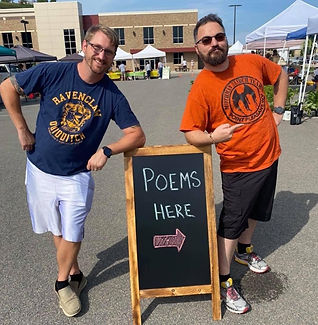

Since 2014, at markets and festivals across West Virginia, the Bards of Yellow Wood have set up their table to write poems for people of all ages who ask for them. Daniel, a high school librarian, and English teachers Brian Elliott and Chad Cowell write poems in trade for donations or supplies for local schools. They estimate that they have written more than 4,000 poems and collected untold thousands in school supplies.
I approach the table, give The Bards a dollar to write me a poem. They ask what I would like them to write about. I give them a prompt, “open heart, open mind.” Daniel sets to work. “Come back in 15 minutes,” he says.
A sudden thunderstorm douses StoryFest as I browse other tables. When I come back, Daniel reads me “Runner,” the poem he wrote for me. Then he hands me a sheet of paper, damp from the rain, his handwriting in black ink.
We know each other, so I expect something personal. Nevertheless, this poem makes me cry. He managed to capture things I love, my hobbies and inspirations. I am moved, like so many others who have entrusted a prompt to The Bards.
“… calloused hands like clay earth pull dirt back
So she can whisper love songs at seeds
Plant thoughts there too.
When they
bloom –
flowers open like pollen
seed thoughts in the wind
“These are all rough drafts”
“Poetry while you wait” is more common than you might think. West Virginia Poet Laureate, Marc Harshman, often composes on-demand poetry at fundraisers and events, using an old-fashioned typewriter. West Virginia-born poet Kathleen Rooney and two other poets founded “Poems While You Wait” in Chicago in 2011. In a 2012 article, Rooney writes that they aim to “provide the public an unexpected and unpretentious encounter with poetry, as well as to challenge ourselves with the improvisatory nature of the commissions.”
The Bards add something uniquely West Virginian: grassroots community support. They gather donations for the greater good. The name “Bards of Yellow Wood” comes from Shakespeare and Robert Frost, both of whom wrote poetry for all people.
Bards founders Brian and Daniel met in college when they won different divisions of the same writing contest. “We both wore sweaters over a button up and ponytails and glasses,” Daniel remembers. Kindred spirits, a friendship formed, fathers and teachers who love to write. These days, Daniel works as a librarian at Morgantown’s University High School, and Brian teaches English at Bridgeport High School.
They have had to get past their need to polish the poems or obsess over the quality, Daniel says. “Whatever pops into our head is what we put down, and we don't question it, because it would otherwise be impossible to produce it in fifteen minutes. These are all rough drafts. We give ourselves permission to let it be a version of something that could be something else.”
The Bards began in 2014 on a whim, Brian recalls: “Divine inspiration, I guess.” They had noticed a shortage of books and classroom materials in the schools. So, “as a joke, we said, what if we wrote poems in exchange for those things?” Daniel remembers.
They set up a few times at the Morgantown Farmer’s Market, then Brian arranged a regular gig at the Bridgeport Farmers Market. And they appear at events like StoryFest. “There's been a lot of iterations,” Daniel says. “We've had guest Bards like Chad Cowell, a regular, and once Crystal Good.” The donations go to teachers and libraries.
They have returning customers. At the Bridgeport Farmers’ Market, “we had patrons who were reliably stocking classroom shelves at least biweekly, going, making Walmart trips or bringing us supplies. And when we had some people who would give us a penny or an IOU, and we would write them a poem.” Both kinds of customers are equally important, Daniel says.
They don’t set a price for poems. Their policy: “If they give us a used pencil, we'll write them a poem,”

Click here to read some of The Bards' 15-minute poems.
“Micro moments of joy”
The Bards’ way of creating on-demand poems is inherently West Virginian, in the Appalachian tradition of small-scale community support. People are sometimes standoffish at first, Daniel says, “But after the first person comes up and asks for a poem, and we read their poem to them, there's something that happens that just draws other people … It's just like, oh, that is a place I can go up to. I have a feeling that they see something on that person's face that makes them know, yeah, this is a space that you can go into and have some joy or some trust.”
The Bards have raised thousands of dollars “to purchase books, often class sets of books for other teachers. They donate the supplies to classrooms and communities in need and organizations like Appalachian Prison Book Project. After terrible flooding in 2016, they delivered 300 books to donation stations in two West Virginia towns whose collections were unsalvageable. “We were able to get books in the hands of tons of elementary teachers,” Daniel remembers.
Each book they donate comes from a poem they wrote, Daniel
observes. By being a poet in public, he can fight stereotypes about
poetry and West Virginia. He can contribute to the collective
identify with his poetry. “I want to always challenge the stereotypes
about this place,” he says. He can establish a connection with
someone else, be a role model, and help meet a practical need, all at
once.
This work gives back to the poets. “Being someone who has
repeatedly used a talent or a skill and my time helps make these
micro moments of joy,” Daniel says. Sometimes, “just giving a kid a pack of pencils when they didn't have them.”
Daniel thinks West Virginia is “the best of both worlds” in [SM1] its richness of nature and culture. “In the wild, if you want to be off grid, if you want to be somewhere where there's clean air and beautiful views and maybe a little bit of mystery and danger and spookiness.” He sees the complexity. “There's just a ton of industry. I love that about being able to live here, being able to walk in both of those worlds, both literally and internally.”
West Virginia colors Daniel’s poetry with vivid, living detail. “Anytime I get to talk about West Virginia or rivers or landmarks or something like that in the poem,” he says, “that's where I feel like I have the most validity and strength in my writing.”
Brian loves to make the process of writing accessible to anybody. “Any time you're taking something that is generally considered to be high literature, which is what I’d assume poetry is thought of by most people, and bringing it into a more kind of public space and interacting with people who wouldn't normally interact with that kind of thing, that's a way to push against this aura of anti-intellectualism that we have in our society.”
When people engage with literature in an ordinary setting, Brian feels, it builds their power to enjoy and embrace literacy.
There are always people who try to say you can't understand poetry, Brian points out, “but Shakespeare was writing for the common man.”

“The poems…opened the trust”
Brian and Daniel say they love the moments of connection with people who commission poems. “It's very joyous and very humbling,” Daniel feels. “And you just want to hug them. It definitely creates a micro-relationship that will end, much like the poem.”
But sometimes the relationship doesn’t end. Some customers keep coming back. “I won't share their personal stories,” Daniel says, “but some of them went through things, and I learned things about them. I have no idea why they were so comfortable sharing. The poems did that, I guess, opened the trust.” Trust in human connection and in the writing process can sometimes trigger an outpouring of creativity, he says.
As Brian puts it, “It almost feels like I'm channeling something. It's weird. There are moments that you'll have with somebody that you have no idea who they are, and then you'll hit something that resonates with them so sharply. I guess it speaks to a lot of universal connections that we have and how we can tap into those.”
“I think that's what's beautiful about stories, storytelling, and poetry as a quick form,” Daniel muses. “People will always welcome those things in. And when you're attached to them, you're allowed in too. My name is hanging on a lot of walls with words I wrote above it, and that's a hard thing for part of my brain to reconcile, but that part of my brain sometimes just needs to shut up, because it's still true.”
“I’m fortunate enough to have a little bit of wit and a grasp of the English language and most Sundays free,” Daniel observes. “And it's been way more rewarding than any financial gain I would get from publishing a poetry book.”
Life sometimes has “made it very hard for me to think that I can offer very many valid things.” But then Daniel remembers that he is “someone who has repeatedly used a talent or a skill and my time to make these micro-moments of joy and maybe make some difference with the donations. The knowledge that I did that makes the feelings I have sometimes about myself that aren't positive really hard to defend. It's hard to say that you don't belong when you're doing something that creates belonging.”
What inspires Daniel and Brian to maintain The Bards over the years? “I’d like to say it’s how much we've done for schools or students or something like that,” Daniel says. But I think the truth is we're just addicted to people coming up to us and sharing a piece of themselves with us. Then we write this thing, and then we read it to them.”
Click here to read some of the Bards' 15-minute poems.
Would you like to write poetry on demand in your community?
* Here's an article from The Poetry Foundation by West Virginian Kathleen Rooney.
* Daniel and Brian would be happy to advise anybody who would like to practice poetry on demand in any West Virginia community. Contact them at ....


Sarah Morris, Morgantown, West Virginia native and former high school English teacher, serves as Coordinator for Undergraduate Writing at West Virginia University. Her current research focuses on composition pedagogy, Appalachian identity, and place-belonging. Her research translates into classroom practice in her work with undergraduate writers, into teacher training in her role as program coordinator, and into service work as co-director of the National Writing Project at West Virginia University (NWP@WVU). Her first book, Lessons from "Take Me Home, Country Roads": Identity, (Be)Longing, and Imagined Landscapes, was published by WVU Press in 2025.